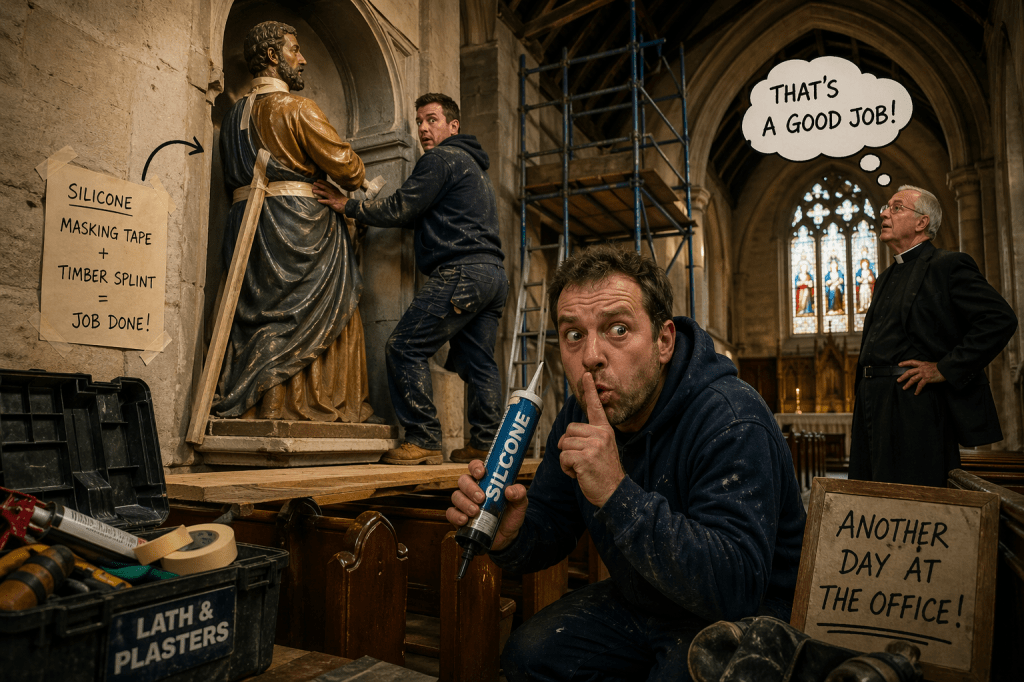
What happens when a routine job in a historic church turns into a full-blown panic? One tradesman recalls the day a priceless statue met an unfortunate accident…
It was the mid-1990s, and I was working for a timber preservation company, tackling everything from woodworm to full-blown dry rot. We had some impressive contracts at the time—large country houses, estates owned by Lords and Ladies, and even projects for the Catholic Church.
One particular job, however, stands out more than most.
The Church Roof Project
We’d been contracted to repair a church roof riddled with dry rot. This wasn’t a quick fix—it was a full strip-out. Every slate had to come off, infected timber joists removed, and the entire structure rebuilt from scratch. The project ran for over twelve months.
Inside, scaffolding filled the church from end to end. Despite the disruption, the building remained open, meaning work had to pause whenever services were taking place. Alongside the structural repairs, we were also responsible for restoring plasterwork and decorative mouldings damaged during the process.
Eventually, the job was complete—or so we thought.
Putting Everything Back Together
A small team of us returned for final checks and to tidy up once the scaffolding had been removed. Like many Catholic churches, this one had several wall niches positioned around ten feet above the ground, each holding religious statues. Before work began, these had been carefully removed and stored.
The priest had made one thing very clear—several times.
These statues were older than the church itself. Around 300 years old. Completely irreplaceable.
No pressure, then.
A Balancing Act
Getting them back into place was no easy task. Each statue was incredibly heavy, requiring two strong lads just to lift one. We laid wooden planks across the pews, creating a makeshift platform, then carefully carried the statues along before lifting them into position.
It was awkward, exhausting, and more than a little nerve-wracking—but eventually, we got them all in place. We stood back, admired our work, and called the priest over.
He was impressed.
Job done… or so we thought.
“They’re in the Wrong Order”
Just as we were packing up, the priest said,
“Sorry lads, but the statues aren’t in the correct order. They need to represent the crucifixion properly.”
He pointed out which ones needed moving—which, in reality, meant all of them.
Off he went.
Out came the planks.
The Moment Everything Went Wrong
We got stuck back in, carefully lifting statues down and swapping them around. We were nearly finished—just one more to go.
As the lads brought one statue down, the replacement—St Peter—was in the way. Knowing how heavy it was, I bent down and dragged it aside.
Then it happened.
The head clipped my knee… snapped clean off… and rolled down the church aisle.
Silence.
Then absolute panic.
“Bloody hell!”
“Oh no!”
“You’ve broken St Peter’s head off!”
This wasn’t just any damage. This was a 300-year-old statue.
Quick… Fix It!
We had seconds to think.
“What do we do before the priest comes back?!”
In a blind panic, we lifted the body back into the niche—headless.
Then someone shouted, “Quick—grab some silicone from the van!”
Out came the sealant. The head was hastily reattached, masking tape wrapped tightly around the neck, with a scrap of timber wedged behind it as support.
A proper bodge job—but it was the best we had.
Did We Get Away With It?
We had just finished when the priest walked back in.
“How’s it going, lads?”
“All done,” we replied.
He looked up. “That’s a good job.”
From the ground, you couldn’t see the repair.
And somehow…
We got away with it.
Aftermath
The banter in the van afterwards—and for weeks to come—was relentless.
And to this day, I still wonder…
Is St Peter’s head still being held on with silicone?

