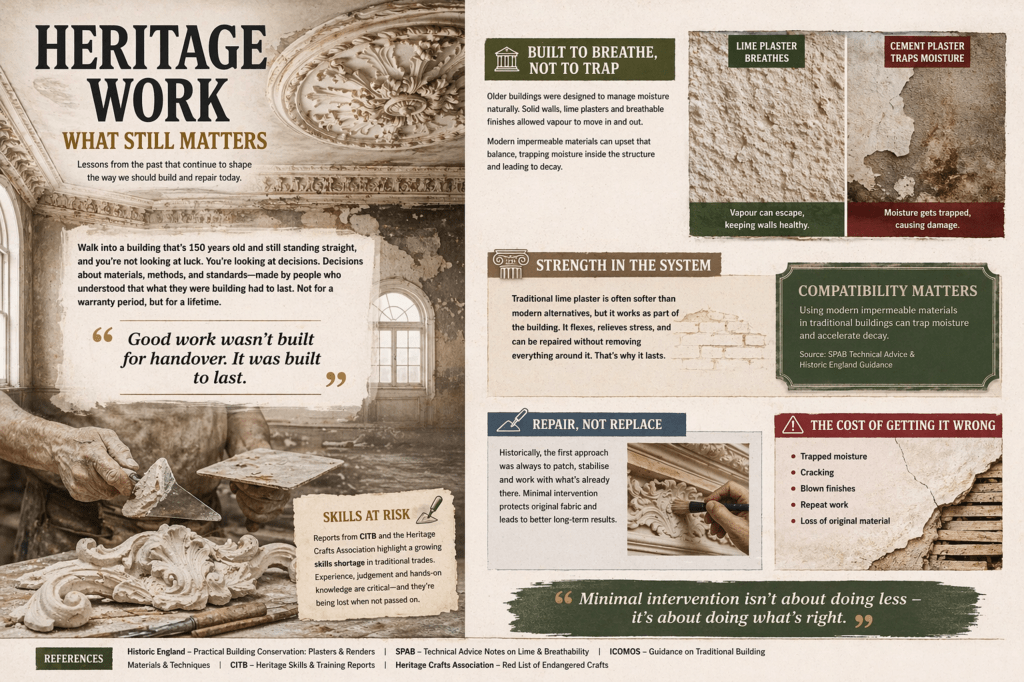
What Still Matters – Lessons from the Past That Build the Future
Walk into a building that’s 150 years old and still standing straight, and you’re not looking at luck.
You’re looking at decisions.
Decisions about materials, methods, and standards—made by people who understood that what they were building had to last. Not for a warranty period, but for a lifetime.
And if we’re honest, that’s where modern work sometimes loses its footing.
🏗️ Built to Breathe, Not to Trap
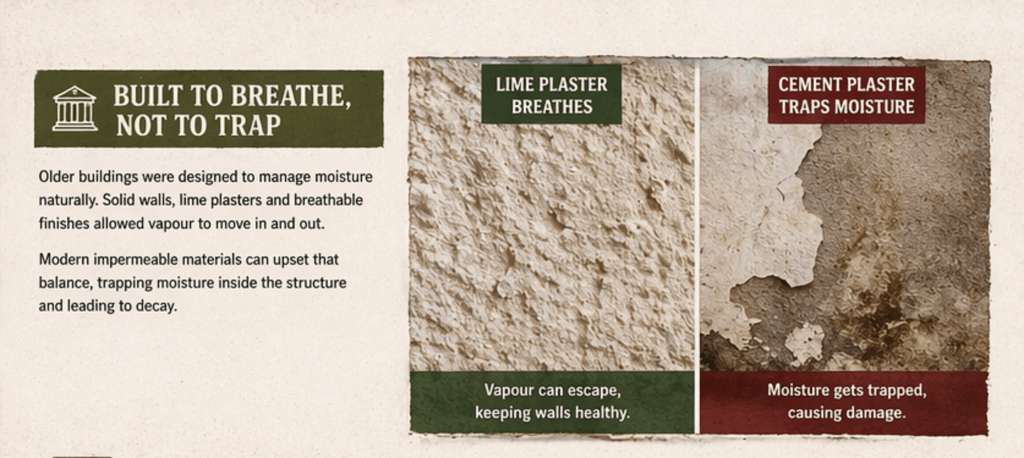
Older buildings weren’t sealed tight—they were designed to manage moisture naturally.
Solid walls, lime plasters, breathable finishes. The whole system allowed water vapour to move in and out without building up pressure.
That’s not theory—that’s why so many of these structures are still sound.
Modern interventions often change that balance.
Introduce dense, impermeable materials into a breathable structure and you create conflict. Moisture gets trapped, salts build up, and before long you’re back on site fixing something that shouldn’t have failed.
That’s not a materials problem—it’s a compatibility problem.
🧱 Strength Was in the System, Not Just the Surface
One of the biggest misconceptions is that older plasterwork survives because it’s “harder” or “stronger.”
It isn’t.
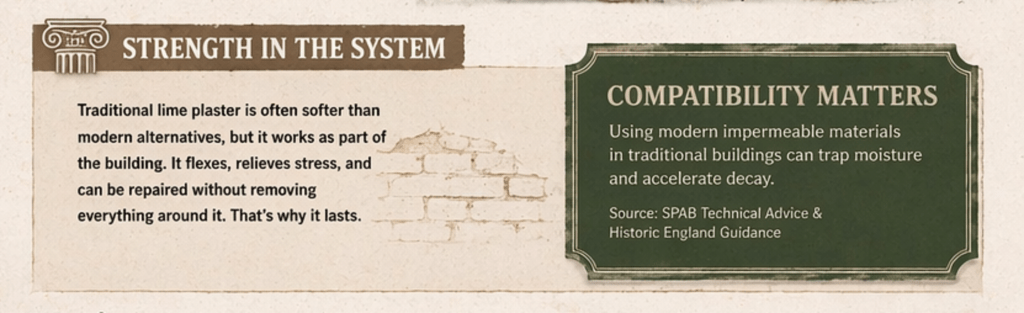
In many cases, traditional lime plaster is actually softer than modern alternatives.
- But it works as part of a system:
- It flexes with the building
- It relieves stress rather than resisting it
- It can be repaired without removing everything around it
- That’s why it lasts.
Modern materials often aim for rigidity. Heritage systems rely on balance.
🔍 Repair, Not Replace
There’s a fundamental difference in approach between traditional and modern work.
Today, if something fails, the instinct is often to rip it out and start again.
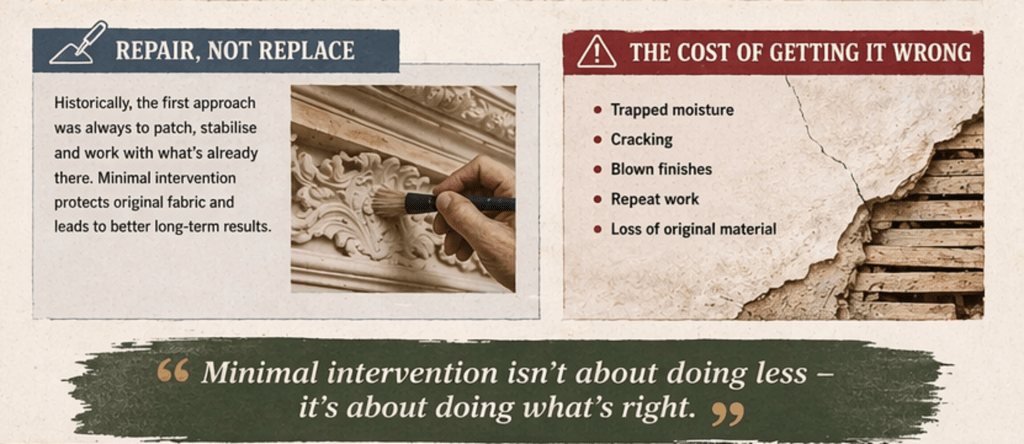
- Historically, the approach was:
- Patch it
- Stabilise it
- Work with what’s already there
That’s not just about saving time or money—it’s about respecting the fabric of the building.
- Guidance from organisations like conservation bodies consistently emphasises:
- Minimal intervention leads to better long-term outcomes.
- Because every time you remove original material, you lose something you can’t get back.
⚖️ The Cost of Getting It Wrong
When heritage work is done badly, the consequences don’t always show up straight away.
That’s what catches people out.
Use the wrong plaster, rush the job, or ignore how the building behaves, and everything might look fine when you leave site.
Give it a year—or five—and you’ll start to see:
- Blown finishes
- Damp patches
- Cracking that shouldn’t be there
These aren’t random failures. They’re predictable outcomes.
And more often than not, they come from applying modern thinking to traditional buildings without understanding the difference.
🧠 Experience Still Beats Specification
You can have all the product data sheets in the world, but they won’t replace time on the tools.
- Heritage plastering relies heavily on:
- Reading the background
- Judging moisture levels
- Understanding how a mix will behave on that specific surface
That kind of knowledge doesn’t come from a quick course.
It’s built over years—often passed from one plasterer to another, job by job.
And it’s exactly the kind of knowledge that’s becoming harder to find.
🧭 Knowing When to Hold the Line
This is where things get real on site.
- You’ll get pressure:
- “Can we speed this up?”
- “Can we use something quicker?”
- “Does it really need to be done that way?”
Sometimes the honest answer is no.
Not because you’re being difficult—but because you understand what’s at stake.
Good heritage work often comes down to having the confidence to say:
This is the right way to do it—and it matters.
🔗 Carrying It Forward
Heritage work isn’t about copying the past for the sake of it.
It’s about understanding what worked—and why—and making sure that knowledge isn’t lost.
- That might mean:
- Training the next generation properly
- Keeping traditional methods in use
- Applying them where they’re needed, not ignoring them because they take longer
Because once those skills disappear, they don’t come back easily.
🔚 Final Word
The buildings we’re restoring today are proof of something simple:
When materials, method, and mindset are aligned, work lasts.
That’s the lesson.
Not everything from the past was perfect—but enough of it was right that we’re still relying on it now.
If the trade wants a strong future, it doesn’t need to reinvent everything.
It just needs to hold onto what already works—and apply it properly.