The First Use of the Darby in Plastering
The darby is one of the most recognisable yet often overlooked tools in traditional plastering. Long, flat, and fitted with handles, it is designed to level wet plaster or render over large surfaces. While modern versions are made from aluminium or magnesium, the origins of the darby stretch back much further into the history of construction and finishing trades.
Early Origins of Straightedge Tools
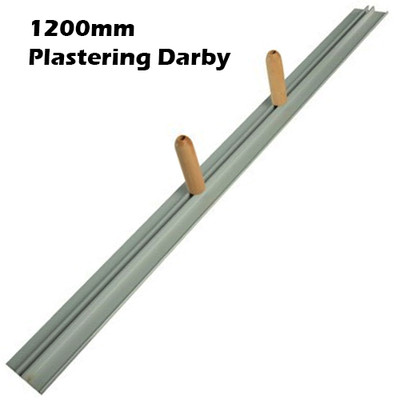
The darby belongs to a broader family of straightedge tools that have existed for centuries. In simple terms, a darby is a hand-held straightedge used to level wet plaster or concrete surfaces, typically ranging from around three to eight feet in length.
Its fundamental purpose has remained consistent throughout history: it removes high spots, fills low areas, and ensures a flat, uniform surface before final finishing takes place.
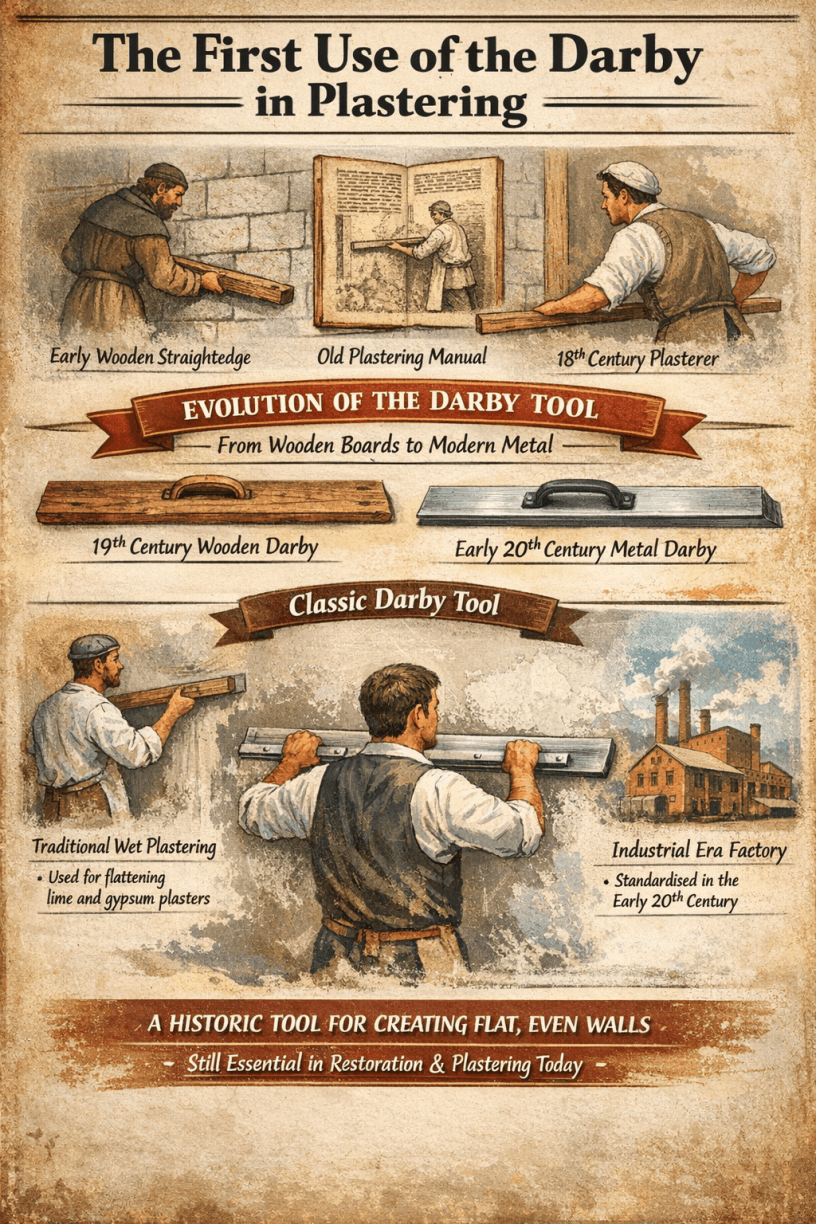
Long before the tool acquired the name “darby,” plasterers and masons were already using primitive wooden straightedges for similar purposes. These early versions would have been simple timber boards used to strike off lime plaster on walls or to level mortar beds. In traditional lime plastering systems—such as those used in medieval Europe—the process required careful levelling of base coats before finishing coats were applied. This need created the conditions for tools like the darby to develop.
Development During Traditional Plastering Eras
The widespread use of the darby likely emerged during the period when multi-coat plaster systems became standard, particularly from the 17th to 19th centuries. During this era, plastering was a highly skilled craft governed by guilds and trade traditions.
Historic plastering methods involved applying several coats: the scratch coat, floating coat, and finish coat. The floating coat required flattening across wide surfaces—precisely the role suited to a darby-type straightedge.
Although specific references to the word “darby” are scarce in early documents, plastering treatises from the 19th century describe tools used to strike and level plaster in ways clearly matching the modern darby’s function. These early versions were typically made from wood, since timber was widely available and easy to shape.
Naming and Industrial Standardisation
The exact origin of the name “darby” is uncertain. Some historians suggest it may relate to regional tool-naming traditions, while others link it to early manufacturers or locations. Regardless of the name’s origin, the tool became standardised during the late 19th and early 20th centuries as construction methods became more formalised.
During the industrial era, plastering tools increasingly shifted from handmade wooden forms to factory-produced metal versions. The introduction of aluminium and magnesium significantly improved durability and weight, making darbys easier to control over large surfaces. Today, a plasterer’s darby is typically described as a long, flat levelling tool with rear handles for control during smoothing and initial flattening stages.
Role in Traditional Wet Plastering
The darby’s importance is closely tied to traditional wet plastering methods. These systems involved applying thick coats of lime or gypsum plaster over lath backgrounds. The darby was used after the plaster was applied with a trowel to achieve initial flatness before finer finishing tools were used. Its function sits between application and finishing: it does not polish surfaces but instead ensures correct plane and alignment. Without this step, surfaces would remain uneven, making final finishing much more difficult.
The decline of traditional wet plastering in the mid-20th century reduced the everyday use of the darby. The rise of plasterboard systems from the 1930s onward meant fewer thick plaster coats were required, and therefore less need for large levelling tools.
However, the tool never disappeared entirely. It remains essential in restoration, rendering, and specialist plastering work.
Modern Use and Legacy
Today, the darby is still considered an indispensable levelling tool in both plastering and concrete finishing. It ensures surfaces are flat, eliminates uneven areas, and prepares the work for final smoothing.
Despite changes in materials and construction methods, its design has changed very little over time. The basic concept—a straightedge used to strike off wet material—has remained consistent for centuries.
In heritage plastering, particularly lime work, the darby continues to play a crucial role. Craftspeople restoring historic buildings rely on it just as earlier plasterers did, demonstrating its enduring value in the trade.
Conclusion
The first use of the darby cannot be pinpointed to a single inventor or date. Instead, it evolved gradually from early straightedge boards used by masons and plasterers centuries ago. By the time multi-coat plaster systems became standard in early modern construction, tools resembling the darby were already essential to the craft.
Industrialisation later refined the tool’s materials and design, but its function has remained unchanged: to create flat, level surfaces during the early stages of plastering. As a result, the darby stands as a lasting example of how simple, practical tools can endure across generations of building trades.
 Lath and Plaster