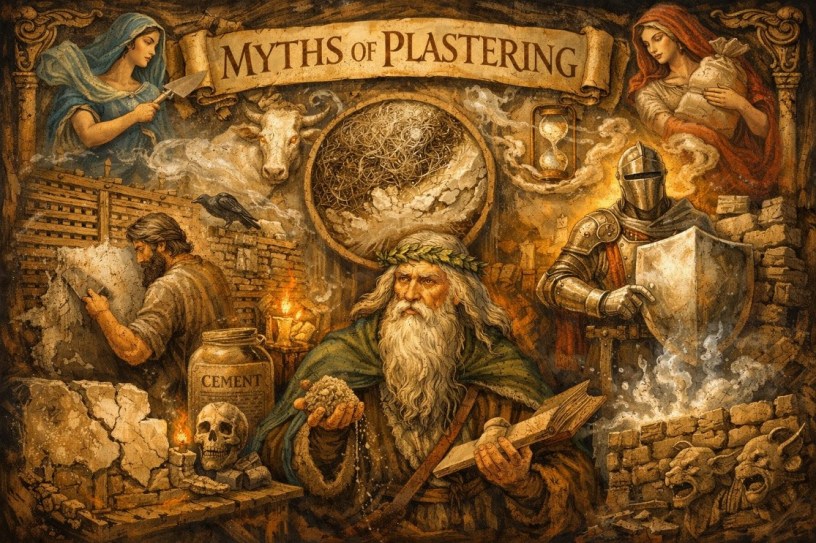
Plastering is one of the oldest building crafts, and like any long-standing trade it has accumulated a fair number of myths. Some are harmless, others actively lead to poor workmanship or inappropriate repairs—especially in heritage buildings. Below are some of the most common plastering myths, explained and corrected.
Myth 1: Old plaster is weak and inferior
Reality:
Historic lime plaster is often more durable than many modern gypsum finishes. Its strength lies not in hardness, but in flexibility and breathability. Lime plaster accommodates slight building movement and allows moisture to evaporate, which is why many centuries-old walls are still sound today.
Myth 2: Cement improves lime plaster
Reality:
Adding cement to lime plaster may increase early strength, but it also reduces breathability and flexibility. This can trap moisture and cause decay in historic masonry. In conservation work, cement is usually the cause of long-term damage rather than a solution.
Myth 3: Cow dung was added to plaster to stop damp
Reality:
This persistent myth has little historical evidence. While animal dung appears in some traditional earth or clay building traditions worldwide, British lime plaster relied on hair fibres, ash, brick dust, and lime chemistry—not dung—to perform properly. Any moisture control came from breathability, not organic additives.
Myth 4: Hair in plaster was unhygienic or symbolic
Reality:
Animal hair (often horse, goat, or ox hair) was added for a practical reason: reinforcement. Hair helps control shrinkage and cracking in base coats. It is a structural component, not a superstition or decoration.
Myth 5: Gypsum plaster is always better because it’s modern
Reality:
Gypsum sets quickly and produces a smooth finish, making it ideal for modern interiors. However, it is unsuitable for damp or historic walls. Lime plaster remains the superior choice where moisture movement and compatibility with old masonry matter.
Myth 6: Lime plaster never sets properly
Reality:
Lime plaster does set—but slowly. Non-hydraulic lime sets by carbonation, reacting with carbon dioxide in the air. This slow process is a feature, not a flaw, allowing extended working time and long-term durability.
Myth 7: Harder plaster means a stronger wall
Reality:
In traditional buildings, plaster should be sacrificial—slightly weaker than the masonry beneath. Overly hard plasters crack, debond, or damage the wall itself. Strength must be appropriate, not maximised.
Myth 8: Sand choice doesn’t really matter
Reality:
Aggregate choice is critical. Particle size, shape, grading, and cleanliness all affect workability, shrinkage, and durability. Many historic failures come from using incorrect modern sands that are too fine or too angular.
Myth 9: Old methods were crude guesswork
Reality:
Traditional plastering was based on deep material knowledge passed through apprenticeship. While ratios were not written down, they were refined through experience and local conditions. The survival of historic plasterwork proves the effectiveness of this knowledge.
Myth 10: Heritage plastering is just nostalgia
Reality:
Heritage plastering is not about romanticising the past—it is about compatibility, performance, and longevity. Traditional materials are often the most technically appropriate solution for traditional buildings.
In summary
Most plastering myths arise from judging traditional materials by modern expectations. Lime plaster was never meant to behave like gypsum or cement—and that difference is precisely why it has lasted so long. Understanding these myths helps ensure repairs respect both the building and the craft.
 Lath and Plaster