Introduction: Why Material Matters
In an age of synthetic paints and fast-curing cements, traditional materials remind us that the old ways endure for a reason. Lime plaster, horsehair, earth mortars, clay plasters, and mineral pigments have shaped architecture for centuries — not only for their beauty but for their technical wisdom.
These materials breathe, move, and age gracefully. They are inherently sustainable, deeply local, and offer performance that modern materials often attempt — but rarely achieve. Understanding them is to reconnect with the essence of craft and the rhythms of nature.
Lime Plaster: The Living Surface
Lime plaster is perhaps the cornerstone of traditional building. Derived from limestone, it’s burned to quicklime, slaked with water, and blended with sand — forming a durable, breathable coating.
Unlike cement, lime plaster carbonates as it sets, reabsorbing CO₂ and effectively returning to stone. This slow, natural process creates a flexible, self-healing surface that allows moisture to evaporate, preventing damp and decay in solid-wall buildings.
Horsehair: The Forgotten Reinforcement
Before synthetic fibres or mesh, horsehair gave plaster its strength. Added to lime or gypsum mixes, the coarse hair acted as natural reinforcement, binding the plaster and preventing cracking as it dried.
Good horsehair — long, strong, slightly oily — creates a fibrous texture that modern conservators still prize. Ethically sourced horsehair remains available from traditional suppliers, sometimes substituted with goat or cattle hair.
Technically, its function mirrors modern fibre additives: it distributes tension evenly across the surface. Yet unlike synthetics, horsehair is fully biodegradable and perfectly compatible with lime chemistry — a lesson in natural engineering.
Earth Mortars: Building with the Ground Beneath Our Feet
Before lime or cement, earth was the builder’s first medium. Earth mortars, made of clay, silt, sand, and straw, bind everything from cob walls to adobe bricks.
Their secret lies in balance: clay provides cohesion, sand gives structure, and straw adds tensile strength. When composed well, earth mortars are elastic, breathable, and infinitely repairable.
In dry or temperate climates, they outperform many modern systems in both thermal comfort and embodied energy. Unlike cement mortars, which are rigid and difficult to recycle, earth mortars can be rehydrated, remixed, and reused — the perfect circular material.
Clay Plasters: Texture, Tone, and Breathability
Clay plasters bring warmth and tactile beauty to interiors. Made with refined clays and mineral aggregates, their hues come naturally from the earth — ochres, siennas, and soft greys — giving walls a serene, organic texture.
Technically, clay plasters regulate humidity. They absorb excess moisture and release it slowly, stabilizing indoor air quality and comfort. Non-toxic, VOC-free, and fully compostable, clay plasters embody the balance of wellness and performance.
Modern producers such as Clayworks, Tierrafino, and American Clay have refined the ancient recipes, ensuring consistency while preserving authenticity. The result is a natural alternative to paint that breathes with the building.
Limes and Pigments: A Natural Palette
Lime extends beyond plaster into limewash — a thin, breathable finish tinted with mineral pigments. Unlike acrylic paints, limewash bonds chemically to its substrate, becoming part of the wall itself rather than forming a film on top.
Natural pigments — iron oxides, ochres, umbers — give limewash its subtle, shifting tones. Because they’re mineral-based, they remain UV stable and compatible with lime’s alkalinity.
When applied in translucent layers, limewash creates surfaces alive with depth and variation, catching light in ways no synthetic coating can replicate. Every wall becomes unique, layered with colour and history.
Sourcing and Sustainability
Traditional materials are inherently local. Lime can be produced from regional quarries, clay dug from nearby soils, and pigments sourced from local mineral beds. This not only reduces transport emissions but also supports regional craftspeople and maintains material authenticity in heritage restoration.
Their sustainability credentials are unmatched: low embodied energy, full recyclability, breathability, and compatibility with natural building systems. They require skill and patience — but reward with beauty and longevity.
Conclusion: Building with Memory
To say material matters is to acknowledge that our buildings are more than structures — they are living systems. Lime, clay, earth, and pigment connect us to geology, climate, and craft.
They teach us that durability and sustainability are not modern inventions but ancient practices worth reviving. Choosing traditional materials is not about nostalgia; it’s about wisdom — about building with the earth, not against it.
In rediscovering these materials, we rediscover resilience, beauty, and the art of making buildings that breathe, age, and endure.
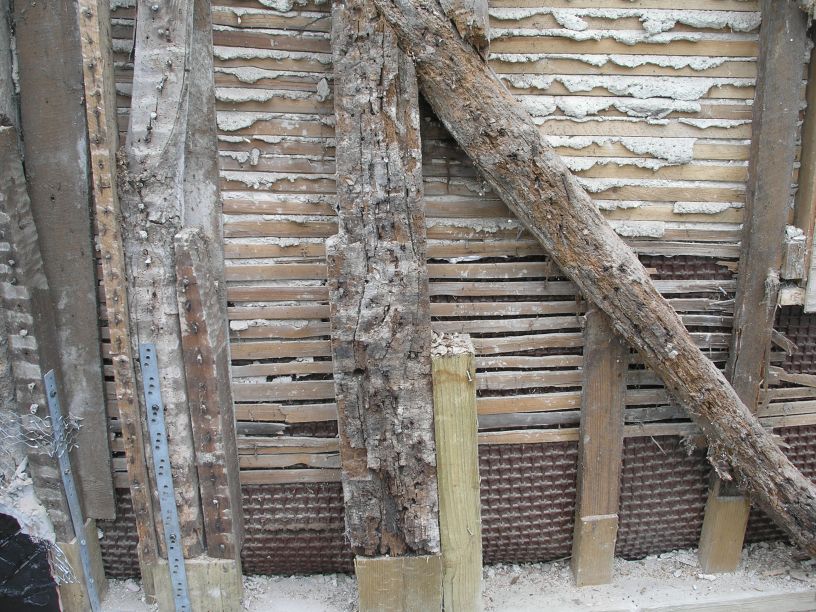
 Lath and Plaster