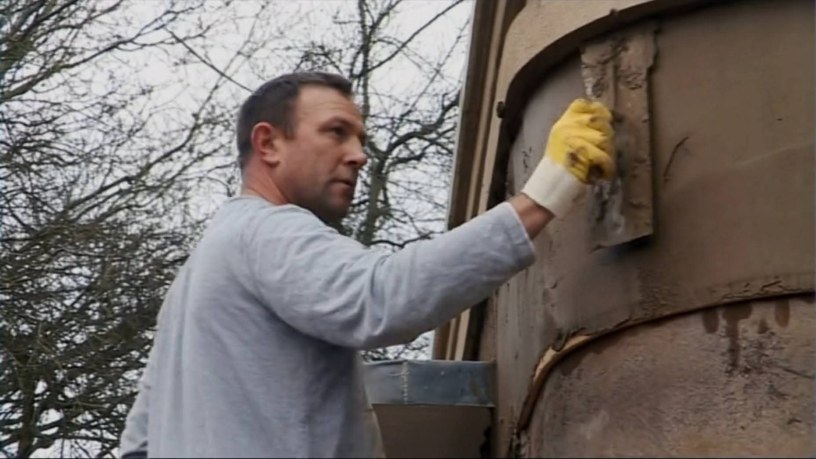
A Craft Feature with Plasterer Adey Higgs
After nearly four decades in the plastering trade, Adrian “Adey” Higgs has carved out a unique niche that blends craftsmanship, creativity, and a touch of artistry. Best known for producing remarkably realistic imitation oak beams crafted from plaster, Adey has transformed what began as a curiosity into a specialist skill that now defines his work.
A Life in the Trade
Adey’s journey into plastering was not a straightforward one. Before committing to the building trades, he experienced a variety of jobs — including time spent in Majorca working around the island’s lively nightclub scene.
“It was a great time,” he recalls, “but when I returned home I knew I needed a proper trade.”
Like many plasterers of his generation, Adey learned through hands-on experience rather than formal routes, developing his skills on site through years of practical work. Domestic jobs, refurbishments, awkward ceilings, and challenging walls all became part of the daily learning curve.
Over time, this foundation of experience built the confidence and competence that would allow him to take on more unusual projects — including one that would even see his work featured on television.
Discovering a Creative Niche
Around thirty years ago, while working on a job in the north of England, Adey was asked to assist with the creation of imitation oak beams.
The concept intrigued him immediately.
“I realised you could create something that looked like aged timber using nothing more than plaster and a few simple tools,” he explains. “The ones I saw at the time weren’t brilliant, but the idea stuck with me.”
What began as curiosity soon became a passion. The work allowed Adey to express the artistic side of plastering — shaping grain, carving knots, and recreating the character of natural timber entirely by hand.
For a tradesman used to skimming walls and ceilings, the creative possibilities were refreshing.
Crafting Timber from Plaster
Adey’s imitation oak beams are produced using plaster over carefully prepared structures, often built around plasterboard boxing. The beams can be used to conceal structural steel beams (RSJs), pipes, or cabling while simultaneously adding architectural character to a space.
Each beam is individually sculpted and textured by hand to replicate the grain, knots, and irregularities found in real oak.
The finished result is remarkably convincing.
“These beams allow people to achieve the look of aged timber without the cost or limitations of real oak,” he explains. “Once they’re finished, most people can’t tell the difference.”
The technique has proven particularly popular in renovations, extensions, pubs, and traditional-style interiors where authentic character is desired but structural or financial limitations make real timber impractical.
A Memorable Moment on Grand Designs
Among the many projects Adey has completed over the years, one stands out as a career highlight — an Art Deco refurbishment in Guildford that appeared on Grand Designs.
The project involved rendering a complex curved fascia, a task that several experienced plasterers on site were hesitant to attempt.
Adey, however, took the challenge on.
“I didn’t overthink it,” he says with a smile. “I just got stuck in.”
The gamble paid off. The result was a success, and both builder and client were delighted with the finish.
“It’s still something I’m proud of to this day.”
Working with the Wider Industry
Much of Adey’s work involves collaboration with other professionals across the construction and design sectors.
Builders, architects, and interior designers frequently work alongside him to integrate imitation beams into wider renovation or design schemes.
Although he does not run formal training programmes, Adey has also helped many young labourers and plasterers during his career by sharing practical knowledge and guidance gained through decades on site.
Advice for the Next Generation
For those considering a career in plastering or heritage crafts, Adey’s advice is simple but direct.
“Be diligent, punctual, and reliable,” he says. “The small things matter.”
He emphasises the importance of preparation and awareness on site — keeping tools ready, maintaining a clean workspace, and anticipating what the job requires before being asked.
“Listen to the people with experience around you,” he adds. “But also watch carefully — learn from the things people get wrong as well as what they get right.”
Understanding how work affects other trades, and how the finished job impacts the customer, is a key part of developing into a skilled and respected tradesperson.
Craft, Creativity, and Character
Today, Adey continues to refine and develop his imitation oak beam work, producing installations that combine traditional craftsmanship with creative expression.
For him, plastering is more than simply applying materials to walls — it’s about shaping spaces and bringing character into buildings.
“You can’t go back in time,” he says, “but with the right skills you can recreate the feeling of something that has been there for centuries.”
And with every carved knot and carefully shaped grain, Adey Higgs proves that sometimes plaster can be every bit as convincing as timber.
 Lath and Plaster