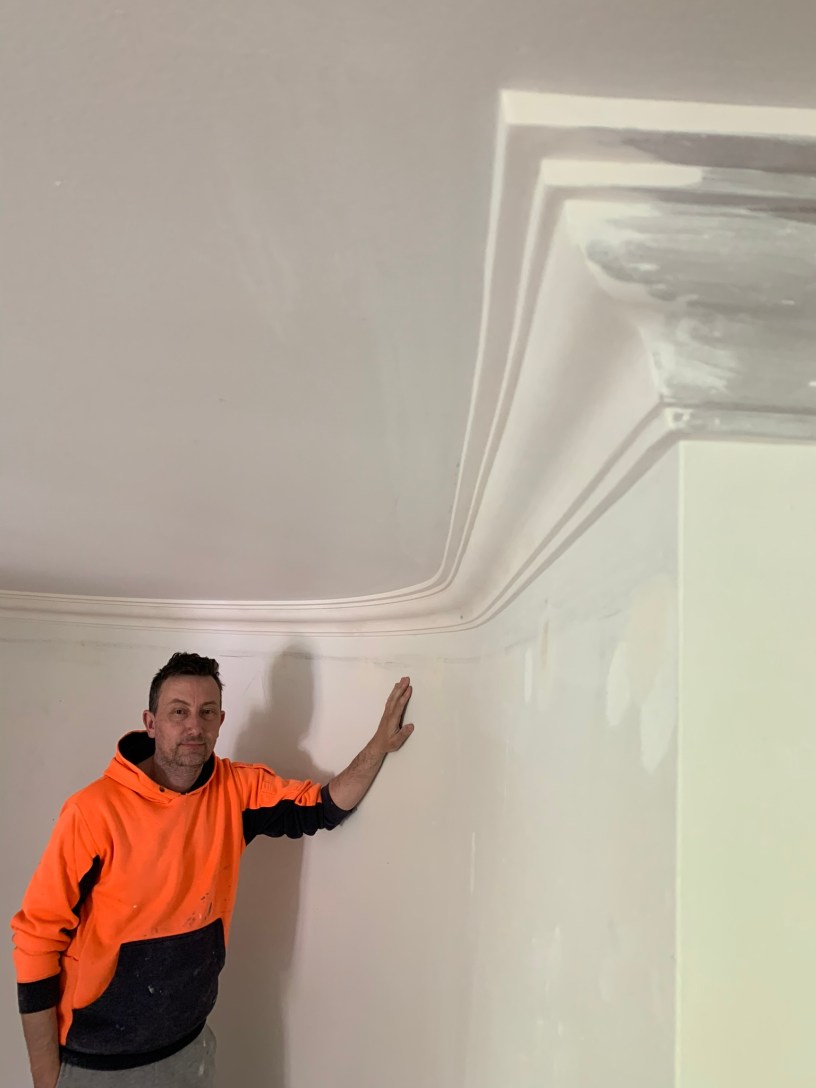
Meet Dean Nash the man preserving plastering’s lost art.
Tell us about yourself and your background
I’ve been plastering most of my life. I started tagging along with my father when I was very young. For many years we worked together, mainly on fibrous cornice work, and we became known for taking on the difficult jobs around Canberra and the surrounding regions. These jobs other plasterers didn’t want to touch or didn’t know how to do.
When my mum became unwell, my father retired and I went out on my own. I spent several years doing a broad range of plastering work, including kitchen and bathroom renovations, general residential work, insurance work and the occasional commercial project.
Then, completely out of the blue, I received a phone call. The only fibrous plaster cornice manufacturer in our area had been evicted, and the landlord was selling the moulds to recover years of unpaid rent. He thought I might be interested. My wife and I went out to have a look, one thing led to another, and we were offered a deal we couldn’t really refuse.
That was nearly ten years ago now, and we’re still here, manufacturing fibrous plaster products and taking on genuinely interesting plastering projects along the way.
As I’ve got older, I’ve found myself gravitating more toward work that really challenges me. It’s the sort of work the average plasterer doesn’t want to do. I have a strong interest in heritage restoration. While heritage work is limited in my region due to the smaller number of older buildings, I’ve been fortunate to work on some significant projects. These include a house built in 1866 in Boorowa, New South Wales, extensive restoration work at the local railway station dating back to the 1880s, and a current project in Young, NSW, involving a house built in the early 1900s.
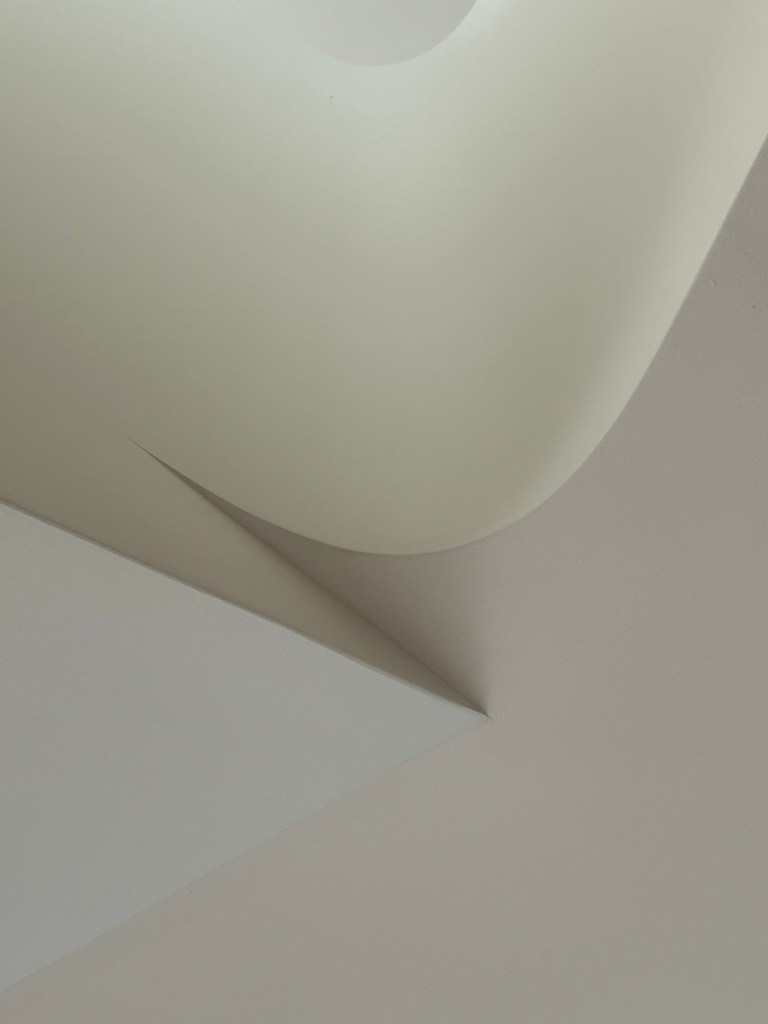
One of my most rewarding recent experiences has been working on helical staircases, including one three-storey and one two-storey. Taking a timber frame, sheeting it, working through the geometry, and bringing it up to a level five finish so people stand back and say, “Wow, those curves are incredible,” is the kind of work I really enjoy.
On the manufacturing side, we specialise in complex and bespoke plaster work. We produce curved cornices and custom plaster elements for major projects, including large-radius curved cornices manufactured for the Australian War Memorial. We’ve also completed bespoke work for Canberra Airport, including a sculpted, wing-shaped plaster feature incorporating lighting and air-conditioning. That project involved multiple curves, tight tolerances, and extensive problem-solving.
I’m 51 now and have been in the trade for well over 35 years. I’m sometimes referred to as “the old bloke who knows cornice,” which still makes me laugh, particularly when younger trades ask about techniques they were never taught at TAFE (Trade School). Skills around decorative cornice, curves, and heritage work are slowly disappearing, and I think it’s important that this knowledge is preserved.
In a nutshell, while I still enjoy producing standard cornice, it’s the more complex and challenging work that keeps me passionate about plastering after all these years.
Describe your specialty or area of expertise
Our core specialty is fibrous plaster, particularly cornice manufacturing and installation. We manufacture decorative plaster cornices locally and supply across Canberra, Queanbeyan, and the surrounding regions, and we also install what we make. That full process of designing, casting, supplying, and fixing on site is something I’ve done for many years and know very well.
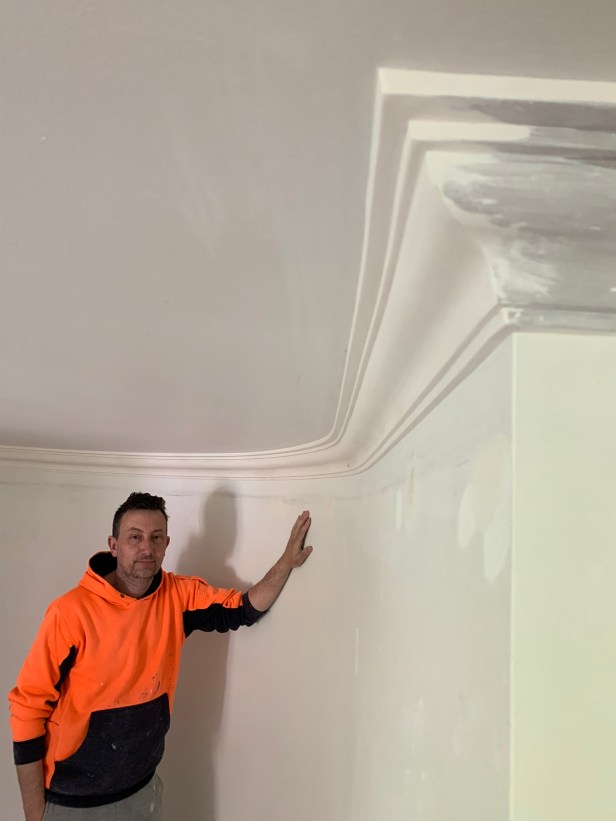
Alongside manufactured cornice, we also run cornice in situ. In our part of Australia, this is extremely uncommon, and we are likely one of the only operators locally still doing it regularly.
Beyond that, my real area of expertise is the more unusual and technically challenging side of plastering. I’m increasingly focused on architectural and heritage plaster work, the kind of jobs that most plasterers either don’t want to take on or simply don’t have the skill set for. That includes heritage restoration, complex repairs, and detailed work on buildings that are a hundred years old or more and cannot be treated like modern construction.
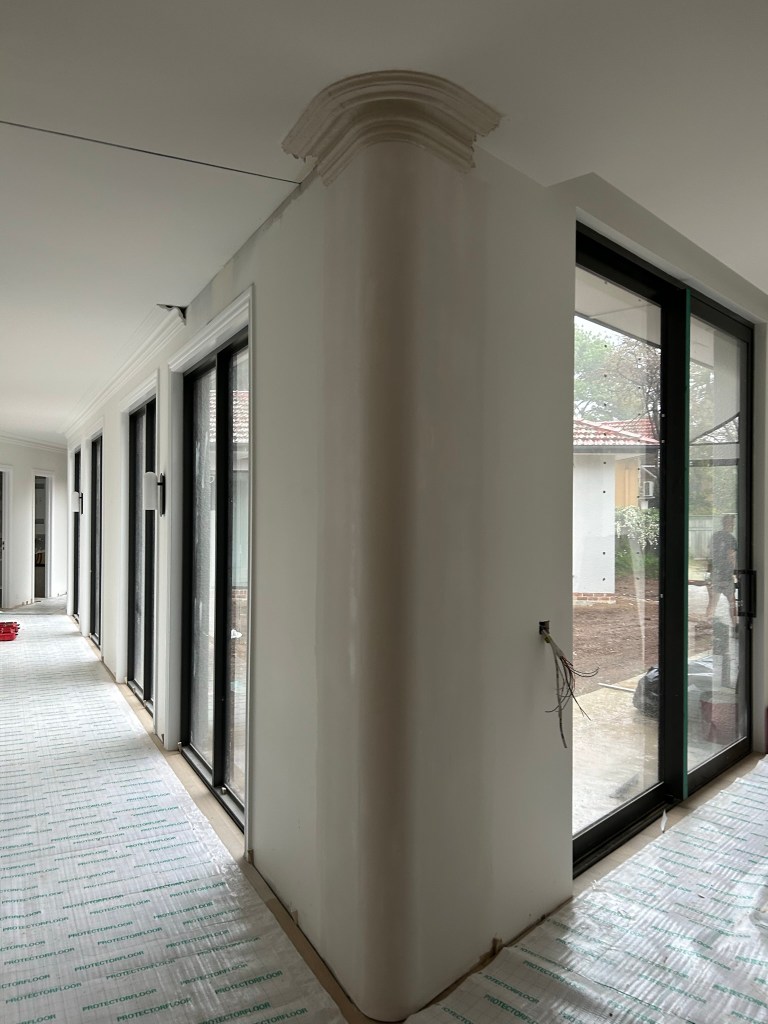
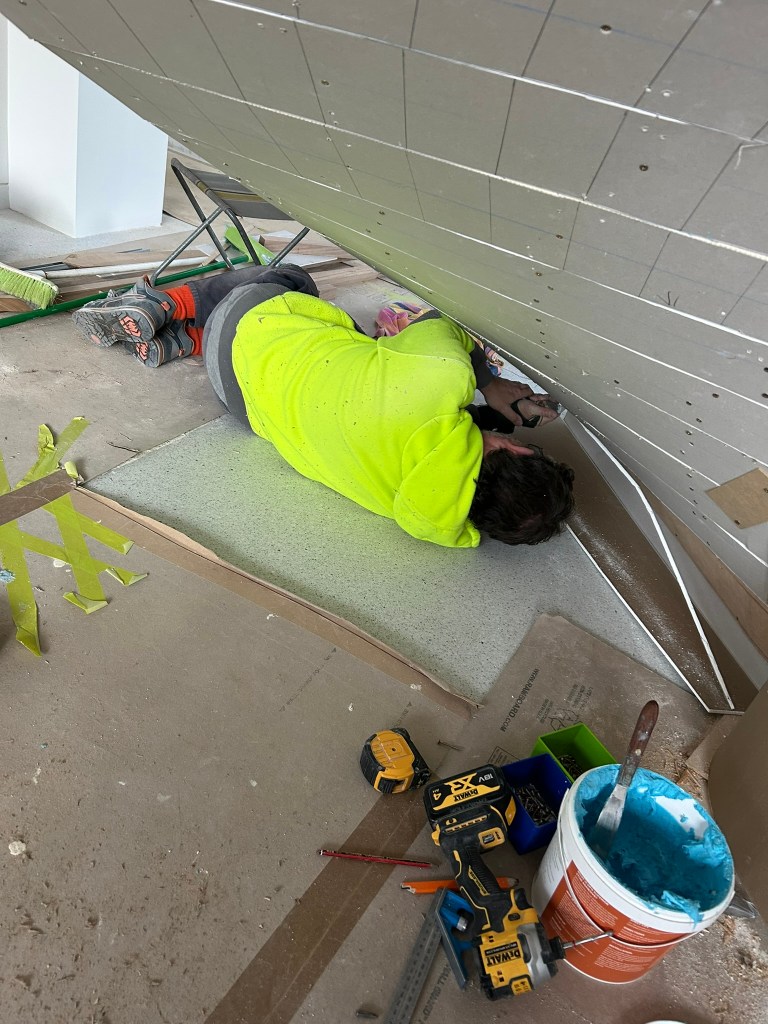
Architectural curves are another major specialty. Curved or helical staircases in particular, including both the visible walls and the undersides of stairs, involve a high level of geometry, problem-solving, and patience. I’ve worked on large multi-storey curved staircases where every surface had to flow cleanly and finish to a very high standard. That sort of work is still relatively uncommon in our region, and it’s something I take a lot of pride in getting right.
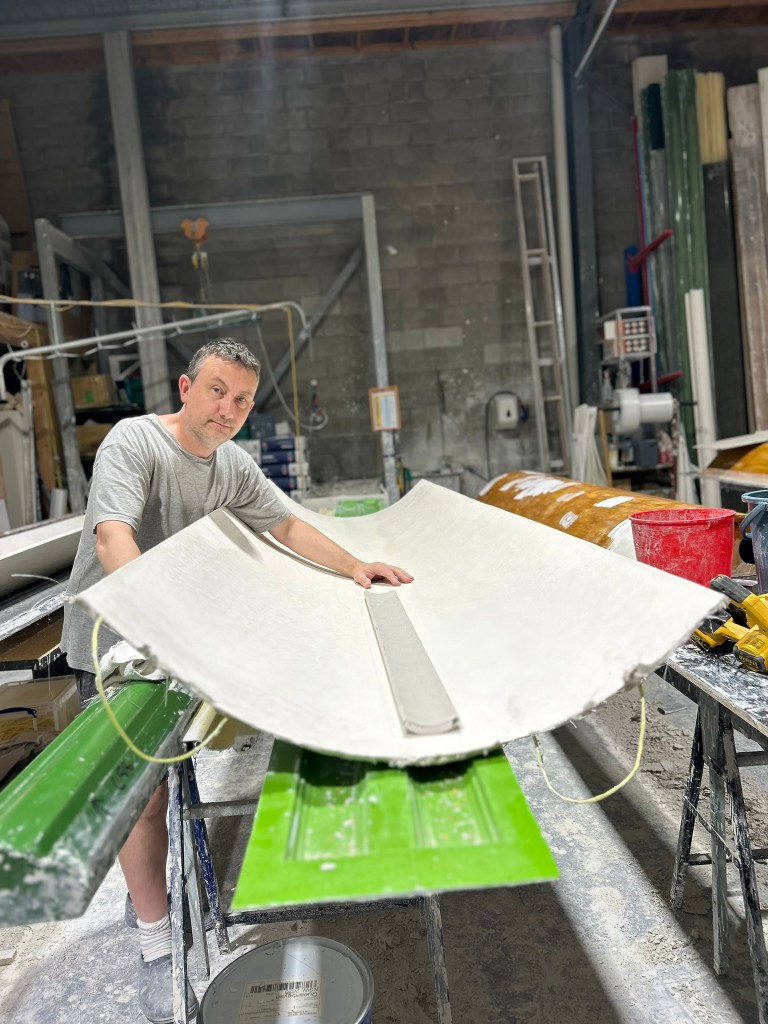
Another key part of what I do is combining manufacturing with on-site problem solving. Whether it’s curved cornice, in situ work, custom mouldings, or one-off architectural details, I’m comfortable designing and making something specifically for a project and then seeing it through to installation.
Overall, my specialty sits at the intersection of fibrous plaster manufacturing, heritage restoration, and complex architectural plastering, particularly curved, in situ, and non-standard work. The more difficult and unconventional the job, the more it tends to suit what I do best.
What made you decide to become a plasterer?
To be honest, I didn’t so much decide to become a plasterer. I was more or less born into it. My father was a plasterer, and during school holidays there was no hanging around the streets with other kids. He made it very clear that I was coming to work with him. From a very young age, every school holiday was spent on site with my dad. A couple of my mates were in the same boat, as their fathers were tradesmen too, so it was simply what we did.
When I was younger, I can’t say I loved it. Like most kids, I would probably have preferred to be doing something else. But as I got older, I started to appreciate the trade, especially the finer and more technical side of plastering. Working alongside my father, we became known for taking on the more difficult fibrous cornice jobs, and that’s where I really began to take pride in the work.
My father originally trained in South Australia as an apprentice fibrous plasterer, back when standard moulds were made from concrete. He went on to work across different areas of the plastering industry, and by the time I came along, plastering was very much part of daily life. Over time, I naturally followed in his footsteps.
What started as something I was simply exposed to from a young age gradually turned into a genuine appreciation for the craft, particularly the precision, the detail, and the satisfaction that comes from getting difficult work right. Looking back now, it really was in the blood, even if I didn’t realise it at the time.
Share one project you are most proud of
That’s a difficult one, because there are two projects that really stand out for different reasons. However, if I had to choose one, it would be the helical staircases.
I worked on two major staircases, one three storeys and the other two storeys, both far more complex than anything I’d done before. While I had worked on staircases previously, nothing had approached the scale or complexity of these builds. What made them particularly challenging was that the original timber framing and basic structure were not well executed, meaning a number of issues had to be resolved before any plastering could even begin.
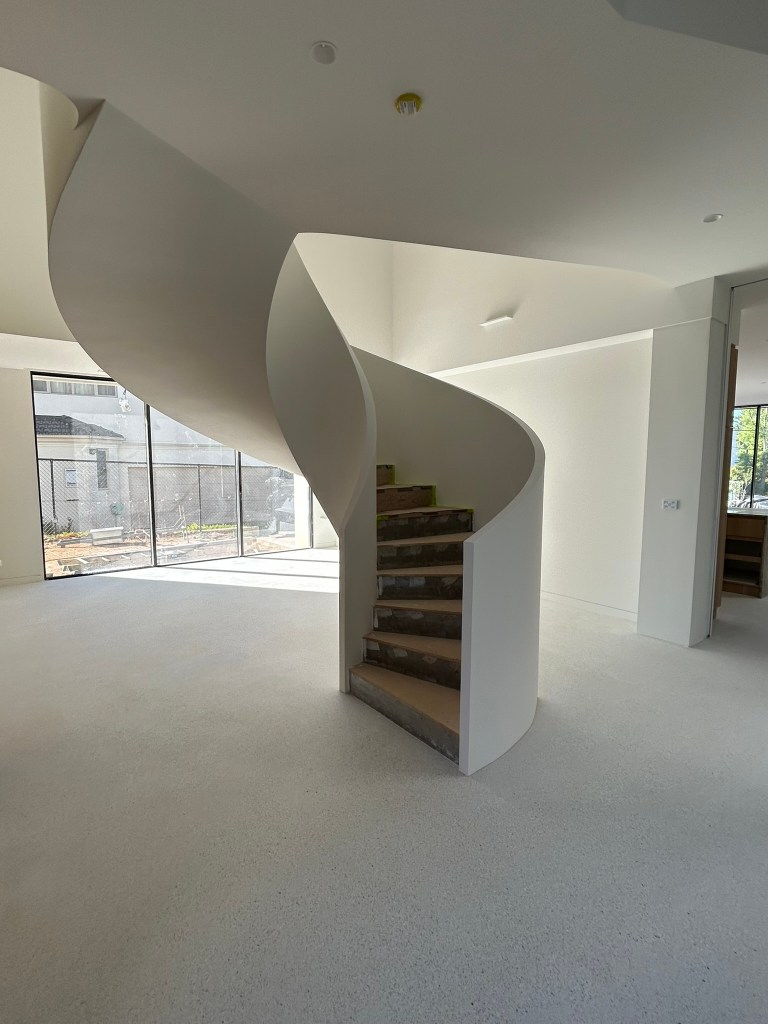
Fortunately, I have a background that includes carpentry, which allowed me to properly assess the structure, identify what needed to be corrected or reinforced, and carry out those changes before sheeting, plastering, and setting. Both staircases shared similar underlying issues, and without addressing these early, the finished result simply would not have worked.
The real challenge was transforming something that was structurally rough into a smooth, flowing architectural feature, particularly underneath the stairs, where curves are unforgiving and even minor errors are immediately visible. Bringing both staircases up to a high-level finish and seeing them come together exactly as intended was incredibly satisfying.
A very close second would be the restoration work at Queanbeyan Railway Station, which I am also extremely proud of. Working on a heritage building like that carries a strong sense of responsibility. However, in terms of technical challenge, problem-solving, and personal satisfaction, the curved staircases are the projects I am most proud of to date.
What advice would you give someone just starting in the plastering or heritage trade?
The first thing I’d say is this: if you’re getting into plastering or heritage work, you need to genuinely enjoy it, especially heritage work. You have to care about old buildings, detail, and doing things properly, because it’s not fast work and it’s not forgiving work.
Beyond the trade itself, my strongest advice would be to learn the business side early. Do some form of business or small-business management course. The hands-on skills will come with time on the tools, but you cannot run a good business without understanding how a business works. That’s something I think apprenticeships and TAFE really miss; there should be a proper module on running a small trade business as part of every apprenticeship.
When it comes to heritage work specifically, research is critical. Read old books, study traditional methods, and talk to older tradespeople. The older generation are a wealth of knowledge, and a lot of that knowledge isn’t written down anywhere. Too often, younger trades dismiss them instead of listening — and that’s how skills get lost.
Ask questions. If you don’t know how to do something, say so. Don’t take on work you don’t understand yet. Heritage work doesn’t give you much room for error, and mistakes are often permanent or very expensive to fix.
So my advice is simple: respect the craft, respect the people who came before you, keep learning, and make sure you understand the business side as well as the trade itself. If you get that balance right, you’ll give yourself a much better chance of having a long and sustainable career.
Is there anything else you’d like our readers to know?
Yes: and this one’s important to me. I want to talk about mental health.
Over the past few years, I’ve struggled quite badly with my own mental health. It’s something I’m still working through, but it has improved, largely because I’ve started talking about it instead of pretending everything’s fine. And that’s something we don’t do very well in the trades, especially among blokes.
There’s still this attitude of “she’ll be right”, but the truth is that a lot of people aren’t right , and chances are, the bloke working next to you or living next door is dealing with the same things. We just don’t say it out loud.
As experienced tradespeople, especially as we get older, we have a responsibility to the younger ones coming through the industry. Not to mollycoddle them, but to let them know that it’s okay to speak up if something’s not right. It’s okay to say you’re having a bad day. We all have days where things go wrong, work piles up, pressure builds, and it just feels heavy and that’s normal.
Getting help doesn’t make you weak. Talking about it doesn’t make you less capable. In fact, it’s usually the opposite.
Plastering is still a very male-dominated industry, and that makes these conversations even more important. It’s great to see more women coming into fibrous plastering, but for the men in the trade especially, mental health needs to be talked about more openly and without stigma.
So if there’s one thing I’d want people to take away, it’s this: you’re not alone, it’s okay to not be okay, and saying something is often the first step to things getting better.
Dean Nash

 Lath and Plaster