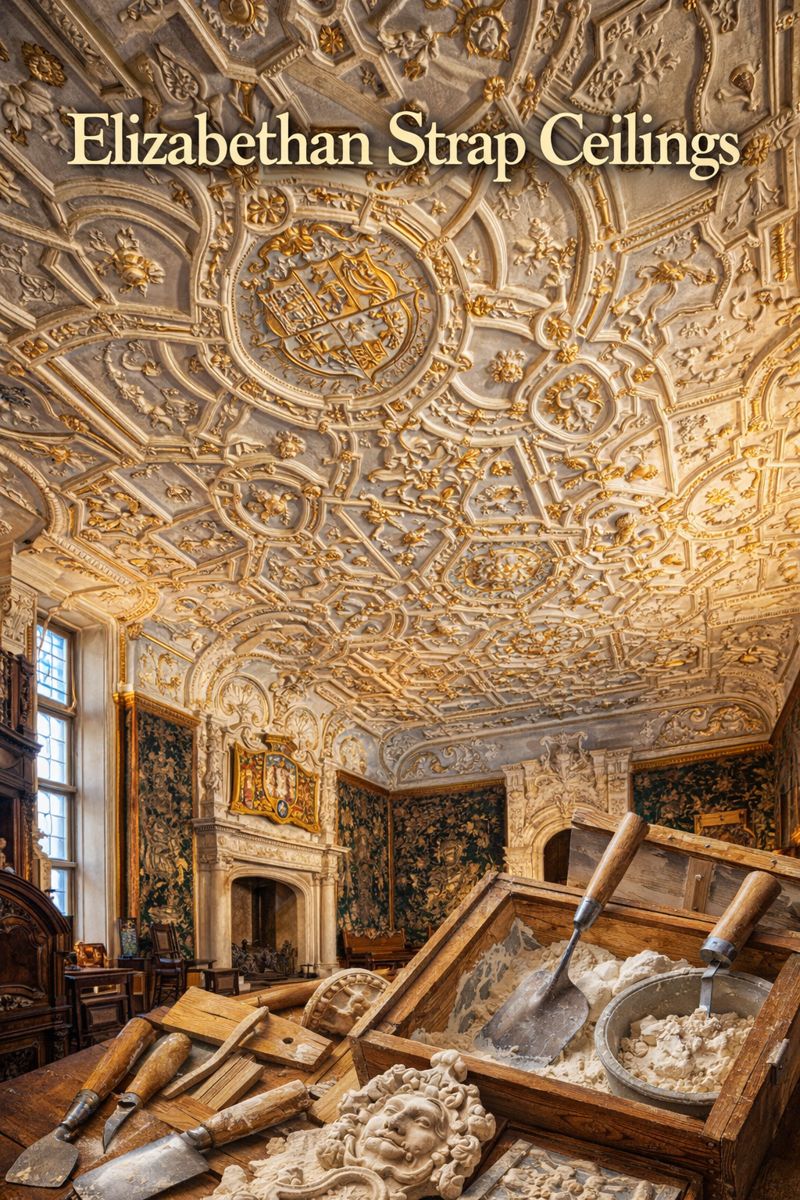
Elizabethan strap ceilings are a type of decorative plaster ceiling made in England in the late 1500s and early 1600s. They are most often found in large houses owned by wealthy families. These ceilings are known for raised plaster lines that cross and link together to form patterns. The raised lines look like leather straps laid across the ceiling surface. This is why they are called strap ceilings.
The strap patterns are not random. They are planned very carefully. Straight lines, curves, circles, and shapes are used to divide the ceiling into sections. Inside these sections, plasterers added small decorations such as flowers, fruit, faces, shields, and round bosses. The whole ceiling worked as one design.
Where strap ceilings were used
Strap ceilings were mainly used in important rooms. These included long galleries, great chambers, and dining rooms. These were rooms where guests were welcomed and entertained. The ceiling showed the wealth, taste, and power of the owner.
Good examples can still be seen today in houses such as Blickling Hall and Hatfield House. In these houses, the ceilings were part of a wider decorative scheme. Walls, fireplaces, and furniture were also richly decorated.
How strap ceilings were supported
Even though the ceiling looks heavy, it is supported by timber. First, wooden beams called joists were fixed across the room. Thin strips of wood called laths were then nailed to the joists. These laths were spaced slightly apart. Wet plaster was pushed onto the laths. Some plaster squeezed through the gaps and hooked around the wood. These hooks are called keys. Once the plaster dried, the keys held the ceiling in place. This system allowed the ceiling to flex slightly as the building moved.
Materials used in Elizabethan strap ceilings
The main material used was lime plaster. Lime plaster was made by mixing lime with sand and water. Animal hair was often added. The hair helped hold the plaster together and reduced cracking. Lime plaster was slow to set. This was helpful for decorative work. Plasterers had time to shape and smooth the raised straps and ornaments. Lime plaster also allowed moisture to move through the ceiling, which helped protect the building.
Gypsum plaster, sometimes called plaster of Paris, was also known at the time. It set much faster than lime. Gypsum was sometimes mixed into lime plaster to make it harden more quickly. This was useful for small details such as flowers or bosses that needed sharp edges.
Timber was another important material. Timber was used for joists, laths, and sometimes for guides to help shape straight plaster lines. Iron nails were used to fix the laths to the joists.
After the plaster work was finished, the ceiling was often painted. Some ceilings were coloured. Others were highlighted with gold leaf. Gilding made bosses and details shine in candlelight.
How strap ceilings were made
The first step was setting out the design. Plasterers used chalk and string to mark straight lines on the ceiling. Compasses were used to draw circles and curves. This step was very important. If the layout was wrong, the whole ceiling would look uneven. Next, base coats of plaster were applied. These coats covered the laths and formed a flat surface. Once this was firm but not fully dry, the raised strapwork was added. Long straight straps were often made by running plaster. A shaped wooden template was pulled along a guide to form the same profile again and again. This kept the straps even and neat.
Smaller decorations were often made in moulds. Wet plaster was poured into the mould. Once it began to set, the ornament was taken out and fixed onto the ceiling. The edges were blended in with fresh plaster. Some parts were shaped by hand. Leaves, faces, and fruit were refined using small tools and fingers. This gave each ceiling a slightly different look.
Tools used by plasterers
Elizabethan plasterers used many tools, some of which are still used today.
For measuring and layout, they used chalk, straightedges, wooden rulers, compasses, and squares. These tools helped keep the design balanced and symmetrical. For fixing the laths, they used hammers, nails, saws, and knives. The laths had to be fixed tightly to stop movement.
For mixing plaster, they used wooden tubs and troughs. Lime and sand were mixed using shovels or hoes. Sieves were used to remove stones from the sand. For applying plaster, they used hawks to hold the plaster and trowels to spread it. Wooden floats helped level the surface. Brushes were used to wet areas so new plaster would stick. For decorative work, they used running moulds, moulds for casting ornaments, and small modelling tools. These included knives, spatulas, and shaped wooden tools. Fine tools were used to sharpen edges and smooth details.
Why strap ceilings were important
Strap ceilings were not just decoration. They showed skill and control. They showed that the owner could afford expert craftsmen and expensive materials. The designs often included symbols of family pride, such as coats of arms or initials. The ceilings also showed links to European design. Strapwork patterns appeared in books and prints that travelled across Europe. English plasterers adapted these ideas into plaster ceilings.
Why strap ceilings still matter today
Elizabethan strap ceilings are important historic features. They help historians understand how people lived and what they valued. They also show how traditional materials worked together.
Today, conservators try to repair these ceilings using the same materials and methods. Lime plaster is still used because it behaves like the original material. Modern hard plasters can cause damage if used in old buildings.
In summary, Elizabethan strap ceilings are a blend of structure, art, and craft. They use simple materials such as lime, sand, hair, timber, and water. With careful design and skilled hands, these materials were turned into some of the most striking interiors of the period.
 Lath and Plaster